Resident Theologian
About the Blog
Cover! Title! Blurbs! Pub date! All the details for my next book…
Read on for all the details about my next book!
I’m pleased to announce that on February 23 of next year—more or less exactly six months from today—Baker Books will publish The Screen-Free Church: How Pastors Can Diagnose and Resist the Spiritual Costs of Technology. Here is the cover:
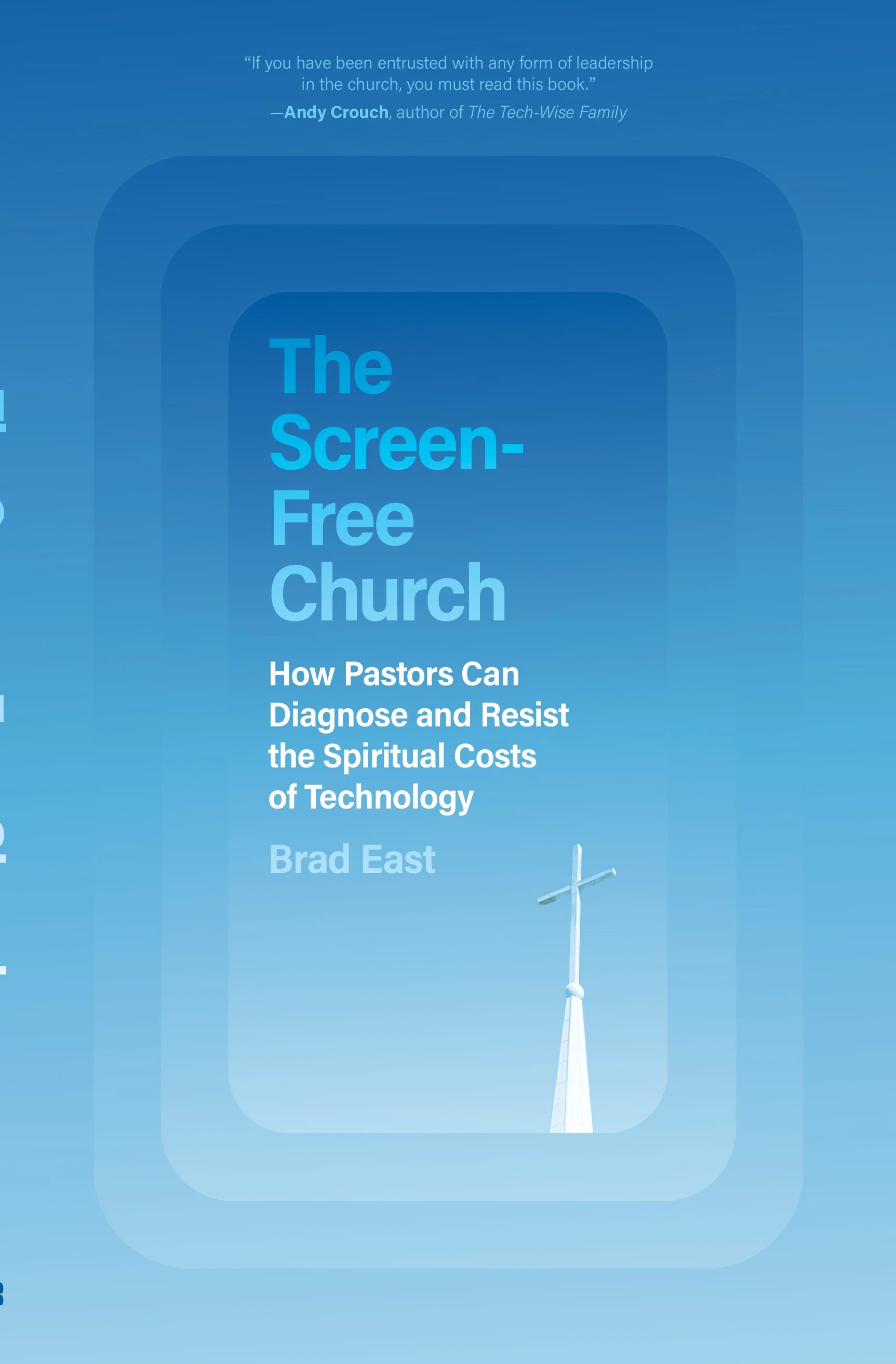
The book is available for pre-order now on Amazon, Barnes & Noble, Bookshop, and Baker.
Here is the publisher’s description:
Our lives are saturated with screens, and digital technology continues to encroach even into our churches.
Brad East argues that resisting this encroachment is a critical task of ministry. Screens sap our attention and drain us of the ability to pray, read, or be still for more than a fleeting moment. In The Screen-Free Church, he reflects on the scope of the problem and offers practical advice for church leaders on reclaiming their congregations, ministries, and worship services—addressing pastors' own relationship with technology as well as their preaching preparation and pastoral care.
The Screen-Free Church will be a lifeline for pastors who want to understand and resist the technological takeover of the church.
And here, without further ado, are the endorsements:
If you have been entrusted with any form of leadership in the church, you must read this book—perhaps not to adopt every one of Brad East’s bracing recommendations, but certainly to grapple with the shape of ministry in a screen-saturated, AI-assisted, post-literate age. I’ve often been asked if I was going to write The Tech-Wise Church, but with this book in the world I don’t have to.
— Andy Crouch, author of The Tech-Wise Family and The Life We’re Looking For
Brad East is a voice crying out in the technological wilderness. In a day when the word “prophetic” is bandied about too easily, this book is actually and truly prophetic—and calls the church back to its prophetic witness. East offers a clarion call to the church to lead in becoming a community of rehumanization. This book is provocative—in the best sort of way. You may find things here you disagree with—but that is the point. These are the conversations we need to be having, the vital disagreements we, as church leaders, must be hashing out. This is the wisdom we should heed. This book is copiously researched and accessible. It is both hopeful and concrete. It is challenging and yet livable. I want to put it in the hands of every single pastor I know.
—Tish Harrison Warren, author of Liturgy of the Ordinary, Prayer in the Night, and What Grows in Weary Lands
The modern church’s approach to the emerging technologies of the digital revolution has basically been to adopt it uncritically, to disastrous effect. Our approach to discernment has been, essentially, “everybody’s doing it.” I.e., no discernment at all. We’re still learning that ‘the medium is the message,’ and for a people whose entire worldview is based on the incarnation of God in Christ, this is a lesson we desperately need to learn in our bones. Brad East has brought his formidable mind and lively heart to the important project of digital discernment. He’s no Luddite, but he offers a clear, compelling, and courageous vision of an incarnational church in a hollow, empty time. I enjoyed this book immensely; I think you will too.
—John Mark Comer, author of Into the Quiet and founder of Practicing the Way
For Brad East to write something and me not to want to read it, it would have to be marked “Classified” in a government silo. This book is no exception. East looks at one of the most pressing crises for the church and gives us not just a word of “why not” but a word of “what instead of all that.” The book will change the way you see your screens, and will help you to see without them.
—Russell Moore, editor at-large of Christianity Today and the author of Losing Our Religion: An Altar Call for Evangelical America
Christians who are not enthusiasts for every new tech product typically want to be measured in their judgments. They say, “Well, it’s only a tool” or “I’m no Luddite.” Brad East isn’t interested in being measured in his judgments. He doesn’t care whether you call him a Luddite. He is instead trying to follow the logic of the Gospel of Jesus Christ wherever it leads, even (or especially) when it leads to a place that makes people think we’re weirdos. This is an uncompromising book, a wise book, and an immensely practical book. Pastors who want to help their congregations to a better world than the one Silicon Valley is promising will find here excellent guidance on just how to do so.
—Alan Jacobs, distinguished professor of humanities in the Honors Program at Baylor University
Brad East has given the church a great gift in The Screen-Free Church: a work that rightly treats the question of digital technology as a robustly theological one, and that properly locates theological reflection in the life of the church. Here is a refreshing firmness of conviction, a call to resist conceding Christian doctrine to the pull of the screen.
—Kaitlyn Schiess, author of The Ballot and the Bible and The Liturgy of Politics
This book is a lucid, erudite, approachable guide for church leaders and for those of us in the pews, taking up the topic of screens and technology as a deeper invitation—to refresh our understanding of human nature itself, and to embrace life as the creatures we are, with and without technology. Refusing broad generalities or blanket prescriptions, East is an ideal scholar to think with on this timely topic. He gives us all a sturdy foundation of theological conviction for building lives together, including intentional constraints that limit and thereby liberate.
—Sara Hendren, author of What Can a Body Do? How We Meet the Built World
There might be no greater challenge to Christian faithfulness than the challenge posed by our modern technological environment, and I cannot think of anyone better positioned than Brad East to offer pastors wise and bold counsel as they navigate these challenges with their congregations. East adeptly deploys both the theological riches of the Christian tradition and the resources of a longstanding tradition of technology criticism to help us understand what is at stake in a world structured by digital technology. The costs are high, and the need for sound judgement is urgent. The Church has a remarkable opportunity to offer an alternative and satisfying vision of human flourishing to a world that is exhausted and demoralized by the inhumane patterns of our techno-economic order. So, I urge pastors and ministry leaders to take up and read this book. More to the point, I hope East’s wise, practical, and charitable counsel is heeded.
—L. M. Sacasas, Executive Director, Christian Study Center, Gainesville, Florida
Far too many contemporary churches are plunging toward the obsolescence that awaits content producers. Along the way, they abandon their members to the deformations of what Brad East aptly terms “screentopia.” East has the sanity to recognize the gravity of this crisis, the courage to take a stand, and the levity to know he doesn’t have all the answers. I’m grateful for such a stirring and practical book to commend to pastors and other leaders who want to imagine how to make disciples and build up the household of faith amid the particular challenges of our technological society.
—Jeffrey Bilbro, professor of English at Grove City College and editor in chief at Front Porch Republic
A vital call to push back on the stories of technological inevitability and on Silicon Valley's powerful sales pitch: that all manner of work, play, study, and prayer must surrender to the digital—for the sake of the future, for the sake of efficiency. Brad East's important and timely book reminds clergy that the answer is found in the spirit and not in the machine.
—Audrey Watters, education technology critic and author of Teaching Machines: The History of Personalized Learning
I wish this book didn't have to exist, but I am so grateful that it does. Brad East unveils, with courage and clarity, the alarming degree to which technology shapes contemporary spiritual conditions--and not for the better. His case is an extraordinarily convincing one. Thankfully, East does not stop at describing our digital impoverishment but points those of us in the Church to the profound and exciting possibilities of a ministry that is emancipated from pixels. An urgent and essential work, in other words, brimming with compassion, practicality, and hope.
—David Zahl, author of Seculosity and The Big Relief
Reading East's book is like opening the window on the first spring day warm enough to get away with it. His advice is an invitation into a bracing, lively world.
—Leah Libresco Sargeant, author of The Dignity of Dependence
The Screen-Free Church is not a cranky piece of analog nostalgia. It's an eloquent, hopeful, and redemptive confession of faith in human ministry. Brad East demonstrates that when we stop ourselves from automatically falling in line with the promises of Big Tech, we (re)discover ways of thinking, teaching, and loving that fill us up instead of burning us out. This is a wonderful book for anyone who loves Jesus' church.
—Samuel D. James, author of Digital Liturgies and Scroll Less, Live More
Even though vigilant against heterodox teachings and deceptive philosophies, many Christians and churches have proven susceptible to more insidious and pervasive distortions of their beliefs and practices occasioned by an uncritical adoption of novel devices. This book is a bracing and timely challenge to pastors to resist and reverse the creeping mediation of the church’s life by screens and other digital technologies. It offers orienting principles and practical steps by which to do so reflectively and effectively, puncturing the myths of inevitability and necessity with which such technologies are surrounded, without advocating reactive Ludditism.
—Alastair Roberts, Professor for Davenant Hall and Adjunct Senior Fellow for the Theopolis Institute
Brad East has great news for Christians: it is not only possible, but necessary and life-giving, to make our churches places where we can be free from the (de)forming power of screens. The journey may be difficult, but we will find the benefits to our prayers and preaching well worth the effort.
—Matthew Loftus, MD, author of Resisting Therapy Culture
It would be impossible to overstate how honored and humbled I am by these endorsements. This book was one of the hardest things I’ve ever written, and it is gratifying to see that some of the thinkers and authors I most admire and respect saw something of value in the finished product.
Much more to come between now and February. But I wanted to finally share the news now that it’s all public and official online. If you are the pre-ordering type, please go ahead and do so. It makes a huge difference, especially for authors (like me) who lack a social media platform. Better still, order copies for your pastor, or for your eldership, or for your church’s lay leadership team! Have me on a podcast to talk about it! I’m sure I’ll be on the pod circuit once the new year arrives.
For now, thanks for reading. I can’t wait for this thing to arrive in the real world.
My latest: low-tech parenting (in CT) and a review of Burge (in FT)
Links to my two latest pieces.
I’ve got two pieces from the past week to share.
First up is a review of Ryan Burge’s new book in the latest issue of First Things, titled “Mainlining Nostalgia.” I respect and appreciate Burge’s work, and enjoyed his previous three books, but I had issues with this one.
Second is an article for Christianity Today called “Low-Tech Parenting Must Be a Big Tent.” In it I argue for strong judgments about tech without the kind of judgmentalism to which parents are always prone. Let’s be tech fallibilists with heavy doses of tech grace.
My latest: the prosperity gospel of college grads
A link to my latest piece for CT.
This week I’m in CT arguing that the prosperity gospel is afoot in upper-middle-class, college-educated Christian circles. It’s not the prosperity gospel you’re used to, though. Instead, it’s a kind of bastardized N. T. Wright for the masses, mediated by well-meaning seminary grads for fellow members of the laptop class. Implicit and sometimes explicit, it calls well-to-do believers to make the world a better place and to stop worrying so much about heaven. When it’s not the social gospel redivivus, when it’s not plain old works righteousness, it’s functionally a permission slip to ignore spiritual things for the sake of earthly things. But forgetfulness of eternity is ultimately avoidance of the gospel, which is never Jesus-plus but Jesus alone. Why? Because the only promise the gospel makes is Jesus.
My (two) latest: on communion wine and a new epistolary novel, in CT
Links to my two latest articles.
In the last two weeks I’ve had two articles go up at Christianity Today. The first is called “Jesus Did Not Serve Grape Juice.” It’s an argument that evangelical and other low-church traditions should serve fermented wine in the Lord’s Supper rather than Welch’s grape juice. Thankfully, as I learned from my inbox afterward, everyone is already in perfect agreement about this, so the argument was probably superfluous.
The second piece went up this morning. It’s titled “This ‘Screwtape for Our Times’ Will Challenge and Confound You.” It’s a review of Ross McCullough’s new book The Body of This Death: Letters from the Last Archbishop of Lancaster. I call it “the best new book you’ll read this year” and “an instant classic of Christian spiritual writing that deserves a wide audience.” It was published today, so order your copy now!
My latest: on pastors and biomedical ethics, in CT
A link to my latest column for Christianity Today.
This morning I have a column in Christianity Today called “So What If the Bible Doesn’t Mention Embryo Screening?” It’s about the kinds of moral and theological questions raised by new technologies that are not directly or explicitly addressed in Scripture, and thus the kinds of intervention and teaching demanded of pastors for the sake of ordinary believers’ guidance in difficult decisions, and the general silence or unpreparedness everywhere in evidence today.
I tried to thread the needle. I’m sure readers will let me know whether or not I succeeded.
My latest: Christmas (in CT) and Kingsnorth (in Commonweal)
Links to my final published pieces in 2025.
Merry Christmas Eve!
I’ve got two final pieces to share for the year 2025. The first is a reflection in Christianity Today on what the birth of Christ reveals to us about God; the second is a review in Commonweal of Paul Kingsnorth’s new book Against the Machine.
The former, in more detail, is a meditation on how the incarnation, especially in Bethlehem, shows us the classical divine attributes, rather than their converse. The latter is an appreciation of Kingsnorth’s thought, work, and writing over the years, proposing his particular combination of essays, poems, and fiction as a worthy successor to Wendell Berry—before concluding with a negative verdict on the book itself. I love Kingsnorth, but in the end the book doesn’t work. I’ll read the next one though. And I’m glad it’s expanded his reach to a new and wider audience. I’m especially excited for a new novel, should it come.
2025: writing
A rundown of what I published in 2025.
As best I can tell, I published thirty total pieces this year: three in academic journals, twelve essays and reviews in ten different magazines, and fifteen columns for Christianity Today. That comes to about two and a half per month, or a little over one every other week.
That number’s going to come down in 2026. It’s the result of a sixteen-month sabbatical from teaching, and it doesn’t even count the talks and lectures, the travel, the podcasts, and the things I wrote that won’t be published for another month or two. Plus the grant application, and the book proposal, and the …, and the …
In a word, I over-committed heading back into the fall semester, and I’m intentionally trying to cut back as the spring approaches. We’ll see if I’m successful.
For now, here’s what I wrote in 2025.
*
Academic
“Stephen Fowl and Theological Interpretation: Retrospect and Prospect,” Journal of Theological Interpretation 19:1 (2025): 130–36. Link here.
Frances M. Young, Doctrine and Scripture in Early Christianity, Vol. 1 (Scripture, the Genesis of Doctrine) and Vol. 2 (Scripture in Doctrinal Dispute), in The Heythrop Journal 66:6 (2025): 654–656. Link here.
Philip G. Ziegler, God’s Adversary and Ours: A Brief Theology of the Devil, in Modern Theology (forthcoming). Early access here.
Essays and Reviews
A Future Worthy of Life (Mere Orthodoxy, 7 January 2025). Reflections on Houellebecq, decadence, and dystopian fiction, with an assist from P. D. James.
How to Raise Readers, in Thirty-Five Steps (Front Porch Republic, 31 January 2025). What it sounds like. In my view, my “funnest” piece of the year.
Generation Autodidact (Mockingbird, 12 February 2025). In which I admit how little I’ve read, and try not to be embarrassed about it.
Luddite Pedagogy (Chronicle of Higher Education, 3 April 2025). There are dozens of us!
Goldilocks Protestantism (First Things, 4 April 2025). Probably my most-read piece of the year, at least based on feedback from friends, emails from strangers, and essays written in response to it.
Low Church in High Places (The Public Discourse, 21 May 2025). A follow-up or companion piece to the First Things essay on Protestantism.
Lexicon for the Phenomenon (The Hedgehog Review, 3 July 2025). My aliens essay. This one didn’t seem to get the traction I’d hoped it would. Oh well.
The Stickiness of Religion (The Lamp, 11 July 2025). My attempt to be just to a good book while skeptical of some of the methodological assumptions of the author’s academic discipline.
No Love Lost for Heretics (Los Angeles Review of Books, 30 July 2025). Come for the summaries, stay for the criticisms.
Politics for Losers (First Things, September 2025). If I had to choose, I think this is the best written thing I published this year. I’m happy that, even though Phil disagreed with most of my criticisms, he thought it was fair.
The Connector (Arc, 9 October 2025). This is the one I worked on the hardest. Turns out profiles aren’t easy! With help, I think it turned out all right.
Keeping the Faith (Chronicle of Higher Education, 23 October 2025). This one seemed to vanish into the mist, but I’m really proud of it. A tough book to review.
Christianity Today
A Little Book About a Little Word That Contains the World (4 February 2025). A review of Wesley Hill’s book about Easter.
Ross Douthat Bets on Belief (11 February 2025). A review of Douthat’s book on religion.
Baptism Is Not Optional (18 March 2025). A 3,000-word invitation to evangelicals to have a higher, sacramental view of baptism.
Christians Are Conspiracy Theorists (2 April 2025). An attempted intervention in the conspiracy theory discourse.
How Dude Perfect Won Me Over (28 April 2025). A fun little candy bar of a column.
Finally, a Tech Book That Doesn’t Pull Punches (3 June 2025). A review of Clare Morell’s new book on teens and smartphones.
Just Say No to Online Church (10 June 2025). A critical review of a new book commending hybrid worship. Probably the most negative thing I’ve ever written.
The God Who Must Not Be Named (1 July 2025). A plea for gentile Christians to stop enunciating YHWH aloud in Christian worship and preaching.
Put Down the Shofar (4 August 2025). A plea for gentile Christians to cease and desist from ethno-religious cosplay.
Hating Hitler Is Not Enough (12 August 2025). A review of Alec Ryrie’s new book.
The Bible Is About Jesus—But Not Jesus Without His Bride (26 August 2025). A review of Jonathan Linebaugh’s new book on Scripture.
The Way We Debate Atonement Is a Mess (16 September 2025). An effort at mediating the PSA wars. I think it threads the needle, but I leave that to others.
You Don’t Have to Be Radical (7 October 2025). A letter to my younger self. I’m not a funny writer, but one line in here made my editor laugh out loud.
In Netflix’s ‘Frankenstein,’ Monster Is More Compelling Than Maker (11 November 2025). A review of Guillermo del Toro’s new film.
In Bethlehem, God Chose What Is Weak to Shame the Strong (16 December 2025). A reading of Christmas as a revelation of classical divine attributes.
My latest: del Toro’s Frankenstein, in CT
A link to my latest piece, a review for CT of Guillermo del Toro’s adaptation of Frankenstein for Netflix.
This past Tuesday Christianity Today published my review of Guillermo del Toro’s adaptation of Mary Shelley’s 1818 novel Frankenstein, or The Modern Prometheus. The title is “In Netflix’s ‘Frankenstein,’ Monster Is More Compelling Than Maker,” with the following subheading: “The Guillermo del Toro adaptation brings unique perspective—but fails to match the depth of its source material.” That’s a fair representation of the review, which is critical of the film but appreciative of some of its virtues, not least Jacob Elordi’s performance and some of del Toro’s marvelous compositions. The last lines of the review sums up my theological take, too.
I must say I love the opportunity to moonlight as a film critic for CT. The original review I submitted was basically a cinematic recap of del Toro’s entire filmography, some of which remains in the final version. Turns out I got multiple degrees in theology and a job as a tenured professor just so I could finally fulfill my heart’s desire as a teenage cinephiliac: to get paid to write about the movies. What a life.
My latest (four): radicals, connectors, gods, and devils
Links to my four latest reviews and essays.
I had four pieces come out in the last month, but I’ve been so busy I haven’t even posted links to the blog. Apologies all. One of my goals for 2027 is to back into the blogging game; all my time for writing and editing has gone to paid pieces, so it’s hard to justify more time here. In any case, here are the relevant links:
“You Don’t Have To Be Radical” (CT, October 7) is a fun little autobiographical ode to the evangelical aughts and the perennial dynamic of young Christians who get it in their heads that there’s only one way to follow Jesus: by being “radical.”
“The Connector” (Arc, October 9) is a profile of the wonderful Leah Libresco Sargeant, timed to the release of her excellent new book, The Dignity of Dependence: A Feminist Manifesto, published in October with the University of Notre Dame Press. Thanks to editor extraordinaire Mark Oppenheimer for getting me to do this, or rather letting me try my hand at it as a non-journalist first-timer.
“Keeping the Faith” (Chronicle of Higher Education, October 23) is a review essay of Kwame Anthony Appiah’s new book Captive Gods: Religion and the Rise of Social Science, published in October with Yale University Press. My first time in the Review.
Finally, the academic journal Modern Theology posted an early-access online version of my review of Philip Ziegler’s new book God’s Adversary and Ours: A Brief Theology of the Devil, which came out in September with Baylor University Press.
My latest (six): UFOs, leftists, Hitler, Scripture, doctrine, and PSA
Links to six new pieces published in the last month or so.
I’ve been remiss of late, not sharing links to my latest pieces when they go up. I’ve had six essays or reviews published since August 7, the last time I posted on this blog. Here’s a quick round-up of links:
“Lexicon for the Phenomenon” is in the latest issue of The Hedgehog Review, and is no longer paywalled. It’s about UFOs, or rather, how we talk about UFOs in public, and the ways theology can shed some terminological light on ufology.
“Hating Hitler Is Not Enough” (CT, August 12) is my review of Alec Ryrie’s new book The Age of Hitler and How We Will Survive It. The book is very good—indeed, welcome and opportune—but the final two chapters, in which Ryrie gives advice to conservatives and progressives, left me underwhelmed.
“The Bible Is About Jesus—but Not Jesus Without His Bride” (CT, August 26) is my review of Jonathan Linebaugh’s new book The Well That Washes What It Shows: An Invitation to Holy Scripture. Wonderfully written and engaging and Lutheran in the best way—but almost completely devoid of the church, both as an encompassing liturgical-sacramental context for the hearing of Scripture and as the corporate communal human agent for the writing of Scripture. Alan thought I was unfair, but I leave you to be the judge.
“The Way We Debate Atonement Is a Mess” (CT, September 16) is my attempt to arbitrate between pro- and anti-PSA Christians, who very rarely either argue well or even get each other’s views right. I’m not much of a PSA-er myself, but nine times out of town I’m unimpressed by the anti-PSA brigade: its posture uncharitable, its rhetoric overheated, its arguments overcooked. Then again, neither are pro-PSA folks faultless in these debates. So I say: Let’s argue better—as Christians.
“Politics for Losers” is in the latest issue of First Things, paywalled for now but not for long. It’s my review of Phil Christman’s new book Why Christians Should Be Leftists. I see that Phil has read it and isn’t angry but isn’t sure whether he’ll reply. While he holds us in suspense, check out some other reviews of the book by Matthew Loftus, Todd Shy, Adam Roberts (paywalled for me), and (not yet published, but forthcoming in Mere Orthodoxy) Bonnie Kristian.
Finally, The Heythrop Journal published my review of Frances M. Young’s two-volume Doctrine and Scripture in Early Christianity. If you know Young, you already know how fortunate we are that we have these two works of extraordinary patristic scholarship. I’ll close this post with the paragraph that opens the review:
Midway through her ninth decade of life, after nearly sixty years of prolific and wide-ranging scholarship, Frances Young offers us, if not a parting gift, then a fitting one: a two-volume summative account of Doctrine and Scripture in Early Christianity. At around 650 pages total, and running from Justin Martyr to Theodoret of Cyrus, or the roughly 300 years from the middle of the second century through to the middle of the fifth, this single work is the capstone to an extraordinary career. The books, articles, and accolades are too many to count. I pause here at the outset, then, instead of waiting until the end, to register my thanks and not a little awe. Young has not only deepened scholarly understanding of early Christianity in all its vast complexity. She has built up the people of God. Would that all of us could say the same.
My latest: gentiles and the Torah, in CT
A link to my latest article for Christianity Today.
Earlier this week Christianity Today published my latest article, called “Put Down the Shofar.” Bluntly stated, it’s a call for gentile Christians to stop cosplaying as observant Jews. It’s written much more gently than that, though. Here’s how it opens:
One day a student approached me after class with an urgent question. The course was on the doctrine of the church, and we’d spent a few weeks on Abraham, Israel, and the law of Moses. Some years back, my student’s family left a mainstream congregation to found a house church which sought to be more like the Christian communities in the Book of Acts. Though Gentiles, they began observing Jewish customs and celebrating the festivals commanded by Moses, including Passover.
My student asked me earnestly, “Were we wrong?” This small church was trying to heed the admonition of James to “be doers of the word,” following “the perfect law, the law of liberty” (1:22–25, RSV throughout). And their logic was impeccable: The Torah (the Hebrew word for the law of Moses) is God’s Word for God’s people. Baptized Gentiles are members of God’s people; therefore, they ought to obey these commands.
The question is not a trivial one, nor is it obscure in American Christian life. You’re likely familiar with shofars blown in public, Seder meals for Passover, and circumcision for baby boys. But as common and well-intended as these may be, I want to explain why I told my student that, yes, his house church was wrong—or at least, misguided. The New Testament is not silent on the question of Gentile observance of the law of Moses. And its answer is a firm no.
My latest: a review of American Heretics, in LARB
A link to my review of Jerome Copulsky’s new book.
I’m in the Los Angeles Review of Books today with a review of Jerome Copulsky’s American Heretics: Religious Adversaries of Liberal Order. Here are the opening paragraphs:
CHRISTIANITY HAS NEVER been certain of its place in the United States. True, from the beginning, it has been more or less acknowledged as the state religion. In fact, the nation’s frontier spirit seized the faith and multiplied it a hundredfold: in the time between George Washington and Abraham Lincoln alone, the former colonies sprung forth Methodists, Mormons, Adventists, and Stone-Campbellites. The US is infamous for its energetic, fissiparous, and entrepreneurial religiosity, a religiosity essentially Protestant in style, if not always in substance.
At the same time, the Constitution is conspicuous in its failure to mention Christ, scripture, or even a generic deity. The government is said to derive its powers from the consent of the governed, not from any transcendent source. The voice of the people supersedes, or perhaps constitutes, the mandate of heaven. Lacking formal establishment or official preeminence, therefore, American Christians have had to rely on the ambient culture, social activism, voting, and sheer numbers to maintain a dominant presence in public affairs. Anxiety about the decline of that presence is itself a long-running measure of Christian involvement in, acceptance of, and alienation from the American project.
It is this third category, the politically alienated, that forms the subject of Jerome E. Copulsky’s recent book American Heretics: Religious Adversaries of Liberal Order (2024). Specifically, Copulsky considers seven groups of Christians who have dissented from the American consensus, in part or in whole. Some rejected democracy; others, disestablished religion; still others, liberal modesty with respect to human nature and the common good. All of them marshaled arguments and movements to reform, repair, renew, or replace the given constitutional order. Copulsky calls his book a “heresiography” of the individuals, ideas, and institutions dedicated to these aims, since they understood themselves to be “theological-political adversaries of the American order” and, thus, “American heretics.” Having departed from political orthodoxy, they stood under liberal anathema. They stand there still.
My latest: a review of Ryan Burge, in The Lamp
A link to my review of Ryan Burge’s new book in the latest issue of The Lamp.
In the latest issue of The Lamp, which just went online today, I have a review of Ryan P. Burge’s new book The American Religious Landscape: Facts, Trends, and the Future. The review is called “The Stickiness of Religion." Here are the opening paragraphs:
Social science fiction—this was Albert Murray’s term of art for the kind of “pseudo-scientific” analysis he saw applied to black life in the 1960s. Too many, he observed, were tempted “to mistake the jargon of social science for insight into the nature and condition of man.” The result was “social science fiction fiction,” namely, novels posing as gritty, revelatory art that merely rendered in narrative form the pathologies and policies proposed by “current survey methodology.” By contrast, Murray’s approach was “distinctly proliterary,” that is to say, humanist in its presumption “that interpretations of human behavior in the raw require at least as much respect for the complexity of human motives as the interpretation of a poem or play or a story.”
Although Murray, a distinguished critic and novelist himself, was primarily concerned with the subject of race in America, his point stands as well for the academic study of religion. Murray may not have known what a “wonk” was, but had he seen one coming down the street, he would have turned and run on the spot.
Ryan P. Burge is the premier wonk of American religion today. A professor of political science at Eastern Illinois University and the author of the Graphs about Religion Substack, Burge has contributed to just about every major newspaper and religious or political magazine. When journalists want to know what’s going on with American religion—usually evangelicalism or Catholicism—they turn to Burge and his trove of ready-made charts. He was at the forefront of popularizing and explaining “the rise of the Nones” and co-operated in the study, published two years ago in The Great Dechurching, that found forty million American adults who used to attend church but no longer do so.
Click here to read the rest. When I wrote the piece I had no idea it would be in the issue commemorating the passing of Pope Francis—nor that I would be just one review separated from Christopher Caldwell. I’m grateful to be included.
My latest: why we shouldn’t pronounce God’s Name, in CT
A link to my latest column for Christianity Today.
I’m in Christianity Today this morning with a column called “The God Who Must Not Be Named.” It addresses the trend, bordering on a fad, of evangelical pastors and scholars pronouncing the Name of YHWH aloud. I sympathize with the reasons why they do so, but argue that they (and we) should not.
Hat tip to Kendall Soulen, whose fingerprints are all over this piece. And hat tip also to my local Sunday morning Bible class, who in May patiently heard a dress rehearsal of this argument when I kicked off a new series on John Mark Comer’s book on the Name.
My (two) latest: reviews of Morell and Huerter, in CT
Links to my two latest reviews in CT.
Last Tuesday Christianity Today published my review of Clare Morell’s new book The Tech Exit: A Practical Guide to Freeing Kids and Teens from Smartphones. The title is “Finally, a Tech Book That Doesn’t Pull Punches,” and that captures the tone of the review, which is overwhelmingly positive. Morell has officially joined my personal Mount Rushmore of tech books to assign and recommend to others—alongside Crouch, Haidt, and Newport.
Michael Huerter’s new book is not among them. This morning CT published my review of Huerter’s book, titled The Hybrid Congregation: A Practical Theology of Worship for an Online Era. In fact, “Just Say No to Online Church” is probably the most negative book review I’ve ever written. The opening sentence is a single word: Nein! That probably tells you all you need to know. But it’s worth reading on for the issues that Huerter raises for pastors and theologians alike. If DJ Soto, bishop of the metaverse—i.e., “Virtual Reality Church and MMO Church”—didn’t exist, we’d have to invent him. But he does, and the claims he makes call for an answer. For the time being, this review is mine.
My latest: the fate of American Protestantism, in Public Discourse
A link to my latest essay in The Public Discourse.
A couple months back First Things published my essay “Goldilocks Protestantism.” An editor at The Public Discourse asked if I might follow that focus on the global context with an essay on the American context. Et voila, I’m in Public Discourse today with “Low Church in High Places: The Fate and Future of American Protestantism.”
Here’s a preview:
Protestantism as we know it, both nationally and globally, is on life support. The Christian world has become either “high,” meaning catholic, or “low,” meaning evangelical. The one includes bishops and priests, liturgy and tradition, creeds and councils, icons and saints, relics and mystics, Mary and monks, whereas the other includes none of the above. The excluded middle is the Protestantism of the Reformation, a “Goldilocks” Gospel that strives to be neither too high nor too low, but just right. By my reckoning, this style of faith makes up no more than 10 percent of global Christianity. In truth it may be as low as 5 percent, and its numbers continue to decline.
That’s the global story. Now I’d like to focus on the national story. As Hemingway once described the onset of bankruptcy, American Protestantism collapsed slowly, then all at once. Precisely while it was building to an extraordinary, dominating height in the 1960s, its competitors and eventual replacements were growing as well, biding their time. They only had to wait. Termites had long since found their way to the foundation. Once it was destroyed from within, there was no way to reverse the damage. The house was doomed to fall.
Let’s date the pinnacle to the late 1950s. By one estimate, in 1958, more than half of all Americans belonged to a “mainline” Protestant denomination. Think Methodist, Lutheran, Presbyterian, Episcopalian. It’s a mistake to wonder how many of these were “actual” as opposed to “nominal” Christians. The social prestige was the point. A prestigious institution is powerful just to the extent that it attracts members regardless of their beliefs. The “mainline” was what you belonged to if you aspired to join—or sought the respect of, or wanted to remain in—the class that ran the country. Presidents, politicians, and businessmen placed formal membership in a known and vetted Protestant denomination. They were neither irreligious nor part of the riffraff (fundamentalists, Pentecostals, Mormons). Like Roman philosophers, their private skepticism and unchristian habits were beside the point: civil religion binds society together. Pay your tithes, say your prayers, make the sacrifices; otherwise the center might not hold.
The center did not hold anyway. Today perhaps fewer than one in ten Americans is a mainline Protestant, and most of them don’t go to church. Demographers predict that in the next dozen years this percentage will trend downward until it settles around one to three percent. So what happened?
My latest: on the joys of Dude Perfect, in CT
A link to my latest column for Christianity Today.
My latest for Christianity Today is called “How Dude Perfect Won Me Over.” At one level it’s a sincere thank you letter to DP for giving my boys something silly and fun to watch over the last couple years; at a deeper level it’s an excuse to think out loud about screens, boys, and adult masculinity. At a minimum it’s my attempt to show that I’m not a total Luddite, and that I do live and raise my children in the world as it is and not as I wish it would be…
My latest: Goldilocks Protestantism, in FT
A link to my essay in the latest issue of First Things.
I’ve got an essay in the latest issue of First Things called “Goldilocks Protestantism.” Here are the opening lines:
Imagine a world without Protestantism.
I don’t mean a world without Christians who are neither Catholic nor Orthodox. I mean a world in which there are only two groups of Christians. The first group encompasses believers who belong to ancient fellowships led by bishops and ordained priests, who confess the Creed and their sins and celebrate the Eucharist in a traditional liturgy of word and sacrament. These believers hand on tradition, petition the saints, venerate icons, and baptize their babies. Call them “catholic.”
Call the other group “evangelicals.” They have no creed but the Bible. They have no bishops or priests; instead, they have ministers and elders, who are rarely ordained. They baptize not infants but adults, who can make a public declaration of faith. They reject the interposition of anyone or anything between the individual and Jesus, who is known immediately in the soul and clearly through the Scriptures.
Imagine a world in which every Christian is either catholic or evangelical, with nothing in between. It is a world without Protestantism—for the religion of the magisterial Reformers in the sixteenth century did not desire, commend, or practice either of these options. Theirs was a via media. They baptized babies, recited the Creed, ordained pastors to the service of word and sacrament, practiced baptism and communion as sacraments (not as symbols), and insisted on the validity of the early councils.
The world I invite you to imagine, then, is one in which this middle way—neither Roman nor Anabaptist, both traditional and reformed—has vanished. Is such a world possible? It is. In fact, we are living in it right now. Ours is a world without Protestantism.
Read the whole thing here. For folks who don’t subscribe to the magazine, the essay is not paywalled, though it may seem that way; you just have to create a free account with your email and you’ll get immediate access.
My latest: Luddite pedagogy, in the CHE
A link to my essay in the Chronicle of Higher Education.
This morning I have an “advice” essay in the Chronicle of Higher Education called “Luddite Pedagogy: It’s OK to Ignore AI in Your Teaching.” From the middle of the piece:
Although I’ve had, over the years, a handful of mild objections to my classroom tech principles, my students rarely if ever complain. They don’t negotiate or beg for relief. A few years back, they even voted me Teacher of the Year. Far from coming at me with pitchforks, in fact, a majority of my students thank me for my “strict” rules. Why? Because they’re well aware of the effects the ambient techno-pedagogical infrastructure produces in them.
Take an online grade sheet. It’s perpetually accessible and constantly changing, with every update generating an automatic notification to a student’s phone. That doesn’t relieve anxiety — it exacerbates it. As for the classroom itself, my students know and hate that they can’t concentrate in a typical screen-populated course. They are distracted by their own phone or laptop, and even when they find the will to turn it off, their eyes drift to a classmate’s device.
Put it this way: If we set out to design an environment that would undermine educational success — to interfere with listening, thinking, and conversing, and disrupt sustained focus and rapt attention — we would invent the contemporary college classroom. Why must we accept it as given?
Click here to read the whole thing.
I first described “Luddite pedagogy” here on the blog back in 2018. I see now that Audrey Watters (my ed-tech-critic hero) used the same phrase in 2020, drawing on a 2014 essay by Torn Halves. Haven’t read either yet, but hoping to get to them soon.
My latest: why baptism isn’t optional, in CT
A link to my latest CT column on the sacrament of baptism.
This week Christianity Today published a long column from me—more than 3,000 words!—on baptism. It’s called “Baptism Is Not Optional,” which pretty much cuts to the heart of the matter. I texted a link to a friend and said, “I’ve never been more CoC … or catholic.” And that’s the truth.
Here’s an excerpt from the introduction:
We don’t, thank God, burn or drown fellow Christians over baptism anymore. In fact, talking about baptism today—about getting it right in doctrine and practice and hence about ways of getting it wrong—feels like breaking a ceasefire. Our present ecumenical peace is hard won and fragile. Why threaten to disturb it?
My answer is simple: The truth matters, baptism matters, and too many churches handle baptism in the lackadaisical, emotive, and diminishing way I see in my classroom. So, let’s actually talk about what baptism is, what it isn’t, and what Scripture and tradition teach about it.
Cards on the table: I hold a full-blown, whole-hog “high sacramental” view of baptism. It’s a visible word of the gospel; it’s a means of grace; it’s an effective sign. By the power of God’s Word and Spirit, baptism does what baptism says: It washes you clean. It gives you Christ; it gives you his Spirit; it gives you his saving grace. “Baptism,” as the apostle Peter succinctly puts it, “saves you” (1 Pet. 3:21, RSV throughout).