Resident Theologian
About the Blog
Bezos ad astra (TLC, 4)
In his latest newsletter—is it the best going? It’s up there—L. M. Sacasas writes about what he calls “earth alienation.” He uses Arendt and McLuhan’s distinct reflections on the significance of Sputnik as a frame for considering Jeff Bezos’s recent comments about space exploration and colonization. Here’s where he quotes and unpacks Bezos:
Enneagram anthropology
For years I teased friends and family members—and especially colleagues: pastors love faddish personality tests—about their affinity for the Enneagram. I rolled my eyes and made astrology jokes. I made the requisite asides about pentagrams and its claim to “ancient provenance,” etc. But since you shouldn’t criticize something you don’t understand, I read the book, specifically Ian Morgan Cron and Suzanne Stabile’s The Road Back to You, and lo and behold, I didn’t hate it.
Cats, Catholics, and election
I went to Stonehill’s stock barn. He had a nice barn and behind it a big corral and a good many small feeder pens. The bargain cow ponies, around thirty head, all colors, were in the corral. I thought they would be broken-down scrubs but they were frisky things with clear eyes and their coats looked healthy enough, though dusty and matted. They had probably never known a brush. They had burrs in their tails.
Abraham our contemporary
The Bible is not a human record from the distant past, full of a mixture of inspiring and not-so-inspiring stories or thoughts; nor is it a sort of magical oracle, dictated by God. It is rather the utterances and records of human beings who have been employed by God to witness to his action in the world, now given to us by God so that we may learn who he is and what he does; and the “giving” by God is by means of the resurrection of Jesus.
Be the teacher
It’s an old line: When asked about the experience of teaching, a teacher replies that he learned more from the students than they learned from him. One can understand the impulse, and why the answer endures as a kind of proverb or cliché: it’s an expression of humility; it resists the impression of the master dispensing Knowledge from on high; it conjures a classroom in which student and teacher collaborate together in the search for knowledge; it appeals to our democratic sensibilities; it might even tickle our know-nothing instincts, dormant though they may be.
Dreams and prayers
More than occasionally I dream of people whom I have neither seen nor thought of in years, sometimes near on two decades. I was in high school from 2000 to 2004, and at least once every couple months nowadays a random person from high school—a stranger, not a close friend, someone I might have been “friends” with on Facebook, before I deleted my account—just walks into a dream. Not a weird dream. Not a nightmare. Just populated by people I know as well as the name and face of an almost complete stranger I last saw more than 17 years ago.
Euphemism
Most Eugenists are Euphemists. I mean merely that short words startle them, while long words soothe them. And they are utterly incapable of translating the one into the other, however obviously they mean the same thing. Say to them "The persuasive and even coercive powers of the citizen should enable him to make sure that the burden of longevity in the previous generation does not become disproportionate and intolerable, especially to the females"; say this to them and they will sway slightly to and fro like babies sent to sleep in cradles. Say to them "Murder your mother," and they sit up quite suddenly.
The ache and the Austinite
Richard Beck, my friend and colleague here at ACU, enjoyed my post yesterday on “Needing Jesus” but pushed back on some elements of it. In particular he thought what I took with one hand I gave back with the other. That is, I denied that our hypothetical 26-year old happy Austinite was “secretly unhappy” before waxing eloquent about . . . just how secretly unhappy he must be, sinsick and lacking Jesus as he is. Moreover, he wasn’t sure just how I am (we are) supposed to get Mr. Contentment into church if we aren’t filling him in, through conversation or other means, just how secretly unhappy he is.
Needing Jesus
Start with a man. A young man, to be more specific. He lives in a small but well-furnished apartment in a gentrified neighborhood of Austin (or Chicago, or Brooklyn, or Portland). He’s 26. He’s single, he’s got friends, and he works a reasonably well-paying job with a tech start-up, a consulting firm, or perhaps a non-profit. He eats good food, reads good books, listens to good music. In general he’s a nice guy. He’s not a jerk. He recycles. He has reliably soft-progressive opinions. He voted for Bernie then for Biden. You’d enjoy his presence if you spent an evening with him.
The meta mafia
Here’s something Mark Zuckerberg said during his indescribably weird announcement video hawking Facebook’s shift into the so-called metaverse: There are going to be new ways of interacting with devices that are much more natural. Instead of typing or tapping, you’re going to be able to gesture with your hands, say a few words, or even just make things happen by thinking about them. Your devices won’t be the focal point of your attention anymore. Instead of getting in the way, they’re going to give you a sense of presence in the new experiences that you’re having and the people who you’re with. And these are some of the basic concepts for the metaverse.
Enns and eggs and common sense
. . . not only the practical politics, but the abstract philosophies of the modern world have had this queer twist [of being contrary to common sense]. Since the modern world began in the sixteenth century, nobody's system of philosophy has really corresponded to everybody's sense of reality: to what, if left to themselves, common men would call common sense. Each started with a paradox: a peculiar point of view demanding the sacrifice of what they would call a sane point of view. That is the one thing common to Hobbes and Hegel, to Kant and Bergson, to Berkeley and William James.
Three new essays published: on chronic illness, supersessionism, and blood
I’ve had three new pieces published this week (with two more coming in the next six weeks: when it rains, it pours). Each is a longish review essay of a recently published book by a major author:
A sheep among wolves
If, after reading [this book], you now turn to study the historical evidence for yourself, begin with the New Testament and not with the books about it. If you do not know Greek get it in a modern translation. Moffat’s is probably the best: Monsignor Knox is also good. I do not advise the Basic English version. And when you turn from the New Testament to modern scholars, remember that you go among them as a sheep among wolves.
Anti-sacramentalism
[W]hile sacraments have precarious or penultimate status in religion by and large, it is a distinguishing mark of Christianity that it is decidedly and finally sacramental. If God is one thing humans have to communicate with one another, to the saying of which the word’s embodiment is essential, God is the one thing Christians cannot cease to communicate.
Artists for friends
Should the artists you love love you back? I confess that this question never occurred to me when I was growing up or , as an adult, when I developed a taste for whatever art I happen to take pleasure in. As this question, or rather assertive expectation, hovers like a gibbering ghoul over all our aesthetic and pop-cultural conversations these days, and has done so in increasing emotional intensity with each passing year (or at least it seems so to me), I have found myself asking why it would never occur to me—apart from what I take to be later, more informed and reflective conviction.
Narnia’s saints
Does Narnia have saints? It occurred to me, as I was listening to The Last Battle this morning, that the function of the children in the stories (minus The Horse and His Boy) is analogous to the function of the saints in devotional and liturgical prayer in catholic traditions. There is no question that Aslan alone is King and Lord, but by his will the sons of Adam and the daughters of Eve are sent as ministering servants to the beasts and people of Narnia.
No fads, please
Writing about angels last week, I had in mind not just garden-variety demythologizers but specifically the sort of MDiv-in-hand pastor who reports having “matured” or “evolved” beyond the simple pieties of his upbringing, his denomination, or his own flock. In my experience, nine times out of ten this maturation or evolution, falsely so called, is not the result of actual wide reading in the church’s tradition but rather a function of moving up in the world, as a matter of education, class, or status. That is to say, it’s the product of peer pressure.
(In)defectibility, local and regional
Churches die. Christian traditions die. Denominations die. Whole regions and epochs of once flourishing ecclesial and liturgical life die. Does that sound harsh? It’s certainly cause for lament. But it’s a plain truth of history, and the church’s faith has no grounds for disputing it.
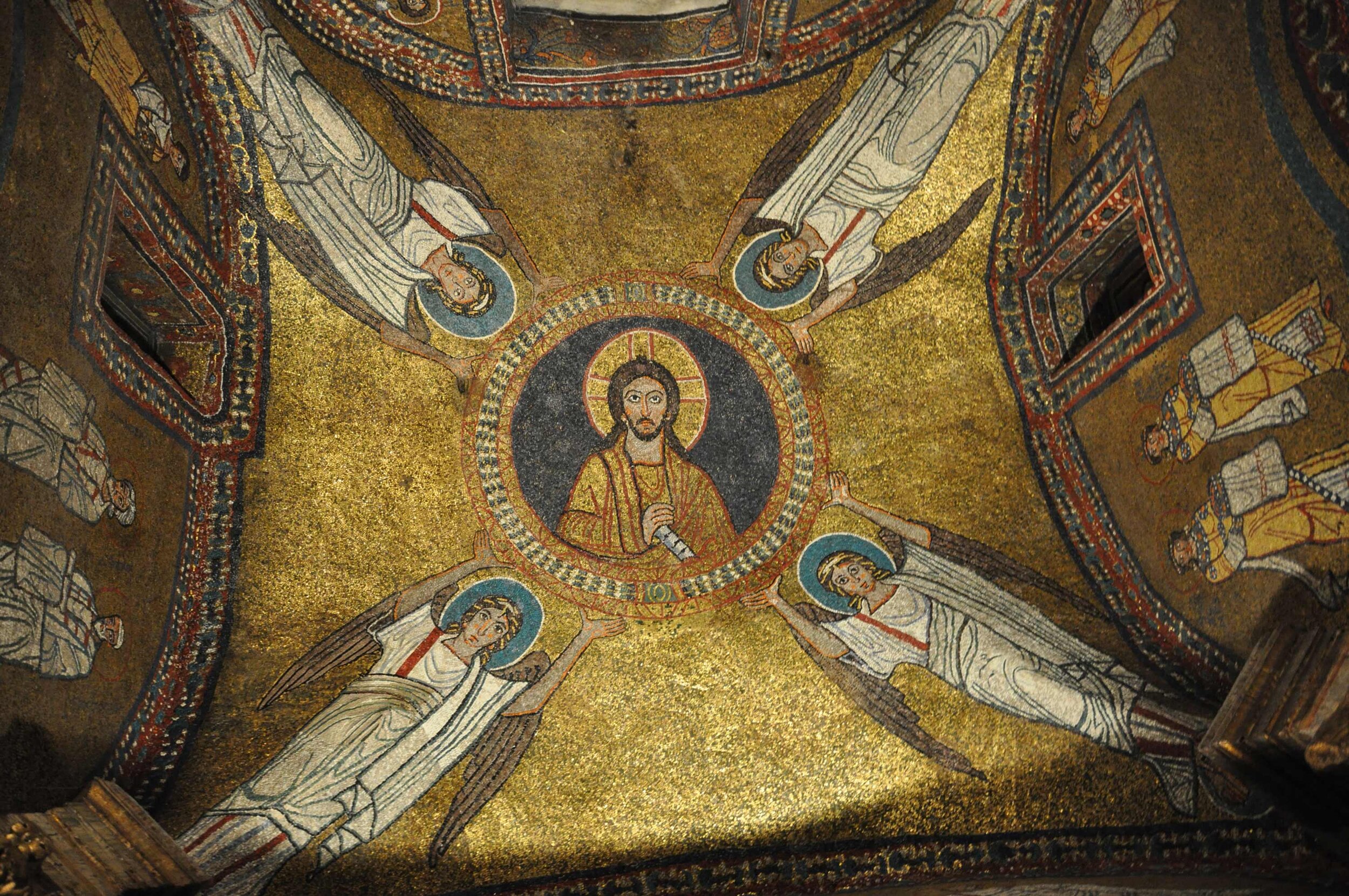
Angels
A few years back I had one of those serendipitous reading moments when all at once an unexpected theme or subject emerges from disparate and seemingly unrelated texts. The first was the Space Trilogy by C. S. Lewis; the second, the Catholic Catechism; the third, On the Orthodox Faith by St. John Damascene. The topic? Angels.
Quit podcasts
“Quit Netflix.” Matt Anderson has made that phrase something of a personal slogan. Among the many controversial things he’s written—he’s a controversialist, after all—it may be the most controversial. We like our shows in the age of Peak TV. And what he wants to do is take them away.