Resident Theologian
About the Blog
Cover! Title! Blurbs! Pub date! All the details for my next book…
Read on for all the details about my next book!
I’m pleased to announce that on February 23 of next year—more or less exactly six months from today—Baker Books will publish The Screen-Free Church: How Pastors Can Diagnose and Resist the Spiritual Costs of Technology. Here is the cover:
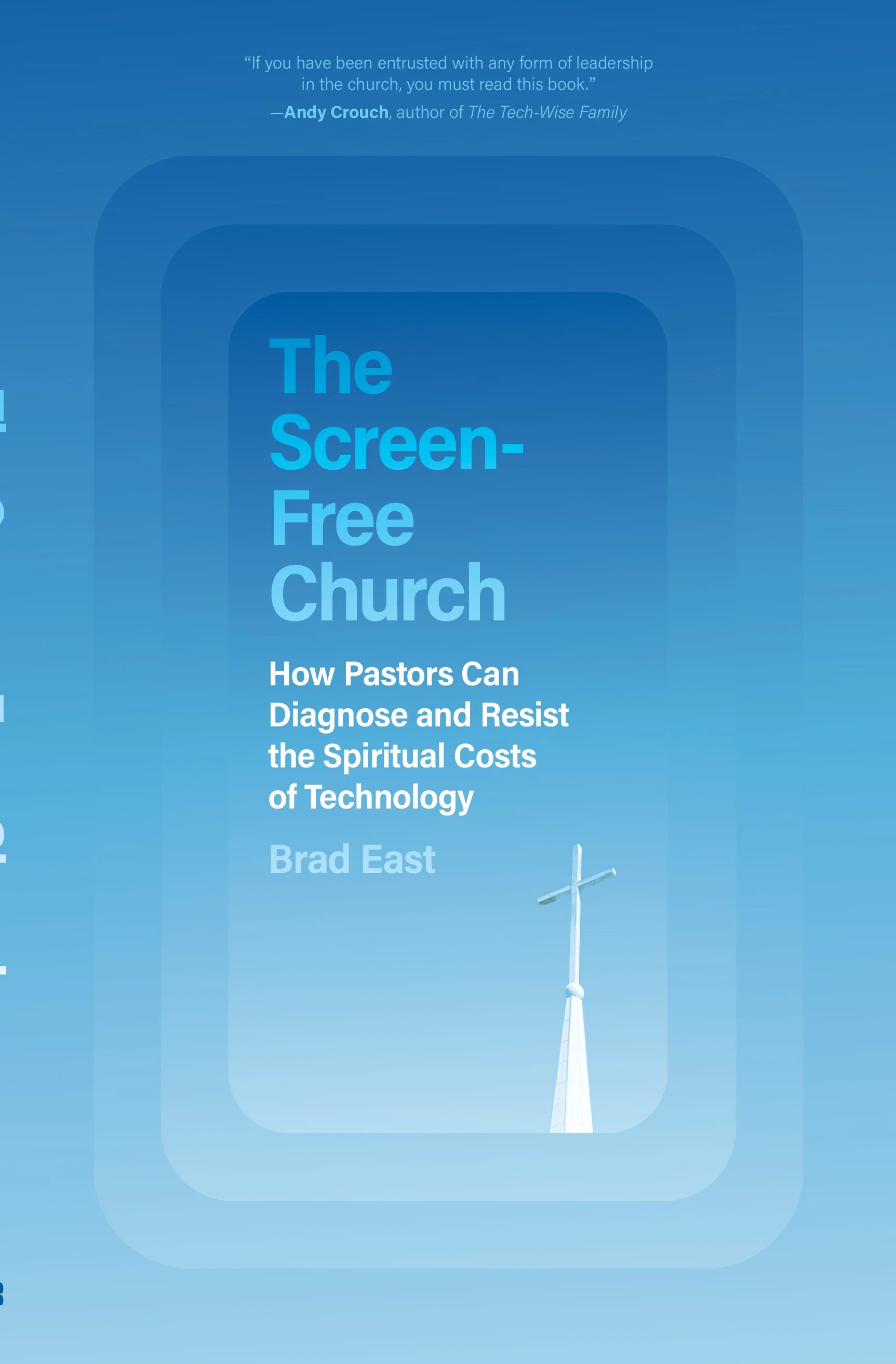
The book is available for pre-order now on Amazon, Barnes & Noble, Bookshop, and Baker.
Here is the publisher’s description:
Our lives are saturated with screens, and digital technology continues to encroach even into our churches.
Brad East argues that resisting this encroachment is a critical task of ministry. Screens sap our attention and drain us of the ability to pray, read, or be still for more than a fleeting moment. In The Screen-Free Church, he reflects on the scope of the problem and offers practical advice for church leaders on reclaiming their congregations, ministries, and worship services—addressing pastors' own relationship with technology as well as their preaching preparation and pastoral care.
The Screen-Free Church will be a lifeline for pastors who want to understand and resist the technological takeover of the church.
And here, without further ado, are the endorsements:
If you have been entrusted with any form of leadership in the church, you must read this book—perhaps not to adopt every one of Brad East’s bracing recommendations, but certainly to grapple with the shape of ministry in a screen-saturated, AI-assisted, post-literate age. I’ve often been asked if I was going to write The Tech-Wise Church, but with this book in the world I don’t have to.
— Andy Crouch, author of The Tech-Wise Family and The Life We’re Looking For
Brad East is a voice crying out in the technological wilderness. In a day when the word “prophetic” is bandied about too easily, this book is actually and truly prophetic—and calls the church back to its prophetic witness. East offers a clarion call to the church to lead in becoming a community of rehumanization. This book is provocative—in the best sort of way. You may find things here you disagree with—but that is the point. These are the conversations we need to be having, the vital disagreements we, as church leaders, must be hashing out. This is the wisdom we should heed. This book is copiously researched and accessible. It is both hopeful and concrete. It is challenging and yet livable. I want to put it in the hands of every single pastor I know.
—Tish Harrison Warren, author of Liturgy of the Ordinary, Prayer in the Night, and What Grows in Weary Lands
The modern church’s approach to the emerging technologies of the digital revolution has basically been to adopt it uncritically, to disastrous effect. Our approach to discernment has been, essentially, “everybody’s doing it.” I.e., no discernment at all. We’re still learning that ‘the medium is the message,’ and for a people whose entire worldview is based on the incarnation of God in Christ, this is a lesson we desperately need to learn in our bones. Brad East has brought his formidable mind and lively heart to the important project of digital discernment. He’s no Luddite, but he offers a clear, compelling, and courageous vision of an incarnational church in a hollow, empty time. I enjoyed this book immensely; I think you will too.
—John Mark Comer, author of Into the Quiet and founder of Practicing the Way
For Brad East to write something and me not to want to read it, it would have to be marked “Classified” in a government silo. This book is no exception. East looks at one of the most pressing crises for the church and gives us not just a word of “why not” but a word of “what instead of all that.” The book will change the way you see your screens, and will help you to see without them.
—Russell Moore, editor at-large of Christianity Today and the author of Losing Our Religion: An Altar Call for Evangelical America
Christians who are not enthusiasts for every new tech product typically want to be measured in their judgments. They say, “Well, it’s only a tool” or “I’m no Luddite.” Brad East isn’t interested in being measured in his judgments. He doesn’t care whether you call him a Luddite. He is instead trying to follow the logic of the Gospel of Jesus Christ wherever it leads, even (or especially) when it leads to a place that makes people think we’re weirdos. This is an uncompromising book, a wise book, and an immensely practical book. Pastors who want to help their congregations to a better world than the one Silicon Valley is promising will find here excellent guidance on just how to do so.
—Alan Jacobs, distinguished professor of humanities in the Honors Program at Baylor University
Brad East has given the church a great gift in The Screen-Free Church: a work that rightly treats the question of digital technology as a robustly theological one, and that properly locates theological reflection in the life of the church. Here is a refreshing firmness of conviction, a call to resist conceding Christian doctrine to the pull of the screen.
—Kaitlyn Schiess, author of The Ballot and the Bible and The Liturgy of Politics
This book is a lucid, erudite, approachable guide for church leaders and for those of us in the pews, taking up the topic of screens and technology as a deeper invitation—to refresh our understanding of human nature itself, and to embrace life as the creatures we are, with and without technology. Refusing broad generalities or blanket prescriptions, East is an ideal scholar to think with on this timely topic. He gives us all a sturdy foundation of theological conviction for building lives together, including intentional constraints that limit and thereby liberate.
—Sara Hendren, author of What Can a Body Do? How We Meet the Built World
There might be no greater challenge to Christian faithfulness than the challenge posed by our modern technological environment, and I cannot think of anyone better positioned than Brad East to offer pastors wise and bold counsel as they navigate these challenges with their congregations. East adeptly deploys both the theological riches of the Christian tradition and the resources of a longstanding tradition of technology criticism to help us understand what is at stake in a world structured by digital technology. The costs are high, and the need for sound judgement is urgent. The Church has a remarkable opportunity to offer an alternative and satisfying vision of human flourishing to a world that is exhausted and demoralized by the inhumane patterns of our techno-economic order. So, I urge pastors and ministry leaders to take up and read this book. More to the point, I hope East’s wise, practical, and charitable counsel is heeded.
—L. M. Sacasas, Executive Director, Christian Study Center, Gainesville, Florida
Far too many contemporary churches are plunging toward the obsolescence that awaits content producers. Along the way, they abandon their members to the deformations of what Brad East aptly terms “screentopia.” East has the sanity to recognize the gravity of this crisis, the courage to take a stand, and the levity to know he doesn’t have all the answers. I’m grateful for such a stirring and practical book to commend to pastors and other leaders who want to imagine how to make disciples and build up the household of faith amid the particular challenges of our technological society.
—Jeffrey Bilbro, professor of English at Grove City College and editor in chief at Front Porch Republic
A vital call to push back on the stories of technological inevitability and on Silicon Valley's powerful sales pitch: that all manner of work, play, study, and prayer must surrender to the digital—for the sake of the future, for the sake of efficiency. Brad East's important and timely book reminds clergy that the answer is found in the spirit and not in the machine.
—Audrey Watters, education technology critic and author of Teaching Machines: The History of Personalized Learning
I wish this book didn't have to exist, but I am so grateful that it does. Brad East unveils, with courage and clarity, the alarming degree to which technology shapes contemporary spiritual conditions--and not for the better. His case is an extraordinarily convincing one. Thankfully, East does not stop at describing our digital impoverishment but points those of us in the Church to the profound and exciting possibilities of a ministry that is emancipated from pixels. An urgent and essential work, in other words, brimming with compassion, practicality, and hope.
—David Zahl, author of Seculosity and The Big Relief
Reading East's book is like opening the window on the first spring day warm enough to get away with it. His advice is an invitation into a bracing, lively world.
—Leah Libresco Sargeant, author of The Dignity of Dependence
The Screen-Free Church is not a cranky piece of analog nostalgia. It's an eloquent, hopeful, and redemptive confession of faith in human ministry. Brad East demonstrates that when we stop ourselves from automatically falling in line with the promises of Big Tech, we (re)discover ways of thinking, teaching, and loving that fill us up instead of burning us out. This is a wonderful book for anyone who loves Jesus' church.
—Samuel D. James, author of Digital Liturgies and Scroll Less, Live More
Even though vigilant against heterodox teachings and deceptive philosophies, many Christians and churches have proven susceptible to more insidious and pervasive distortions of their beliefs and practices occasioned by an uncritical adoption of novel devices. This book is a bracing and timely challenge to pastors to resist and reverse the creeping mediation of the church’s life by screens and other digital technologies. It offers orienting principles and practical steps by which to do so reflectively and effectively, puncturing the myths of inevitability and necessity with which such technologies are surrounded, without advocating reactive Ludditism.
—Alastair Roberts, Professor for Davenant Hall and Adjunct Senior Fellow for the Theopolis Institute
Brad East has great news for Christians: it is not only possible, but necessary and life-giving, to make our churches places where we can be free from the (de)forming power of screens. The journey may be difficult, but we will find the benefits to our prayers and preaching well worth the effort.
—Matthew Loftus, MD, author of Resisting Therapy Culture
It would be impossible to overstate how honored and humbled I am by these endorsements. This book was one of the hardest things I’ve ever written, and it is gratifying to see that some of the thinkers and authors I most admire and respect saw something of value in the finished product.
Much more to come between now and February. But I wanted to finally share the news now that it’s all public and official online. If you are the pre-ordering type, please go ahead and do so. It makes a huge difference, especially for authors (like me) who lack a social media platform. Better still, order copies for your pastor, or for your eldership, or for your church’s lay leadership team! Have me on a podcast to talk about it! I’m sure I’ll be on the pod circuit once the new year arrives.
For now, thanks for reading. I can’t wait for this thing to arrive in the real world.
Letters to a Future Saint: cover, blurbs, pub date, and more!
The title says it all. Click on to see the cover and endorsements and more!
I’m pleased to announce that my next book, Letters to a Future Saint: Foundations of Faith for the Spiritually Hungry, has an official publication date, a cover, blurbs galore, and more. It’s due October 1. Now feast your eyes:
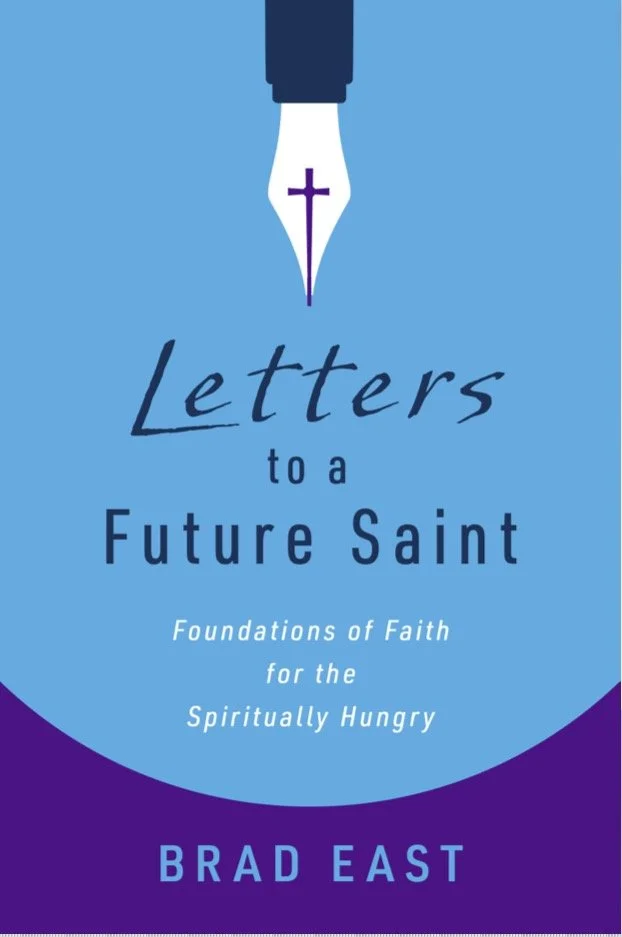
Isn’t that lovely? The theme continues on the inside, too; I can’t wait for folks to see how it’s designed.
Here’s the official book description:
An invitation to the Christian faith for the bored, the distracted, and the spiritually hungry
Dear future saint,
Why is the gospel worth living for?
Why is it worth dying for?
In these letters, a fellow pilgrim addresses future saints: the bored and the distracted, the skeptical and the curious, the young and the spiritually hungry. Lively and readable, these bite-sized letters explain the basics of Christian life, including orthodox doctrine, the story of Scripture, the way of discipleship, and more.
Interweaving Scripture, poetry, and theological writings, Letters to a Future Saint educates readers in the richness of the Christian tradition. But beyond that, this earnest and approachable volume offers young people— who may be largely uninformed of the depths of faith despite having been raised in Christian homes —an invitation into the life of the church and into a deeper relationship with God.
And here are the endorsements, which—well, just read on:
“Rule number one in sharing the Christian faith with young people: don’t patronise. Assume they are morally serious and intellectually curious; that they are in search of a structure that will carry the weight of their anxieties, passions and imaginative energy. And if you start from that sort of point, the book you might well want to put into their hands is something very like this one—clear, respectful, challenging, candid, gracious.”
—Rowan Williams, 104th Archbishop of Canterbury“In this little book, East teaches about the gospel—he catechizes. But its epistolary format allows what could seem tiresome or didactic to become conversational and approachable. These letters tell the story of Jesus in many ways, from many different angles, and with a lightness of touch. They also convey what it might feel like to be a Christian and to think about the world in light of the story of Jesus. If you are someone who cares about young people or those of any age finding their way in the spiritual life—if you care about future saints—read this book and share it with others.”
—Tish Harrison Warren, author of Liturgy of the Ordinary and Prayer in the Night“The letters that Brad East writes here are signed, ‘Yours in Christ, a fellow pilgrim,’ and that tells you most of what you need to know about this wonderful book. It’s a warmhearted, clear-sighted account of life ‘in Christ,’ not pronounced from on high, but narrated by someone a little farther along the Way than the young people it’s addressed to. This is a book to give to many of those pilgrims near the outset of their journey.”
—Alan Jacobs, Jim and Sharon Harrod Chair of Christian Thought, Baylor University“Sometimes catechisms seem to emphasize truth at the expense of life. The parroting back of doctrinal answers to posed questions, while often valuable, can be dangerous for those tempted to think of Christianity as the mastery of syllogisms rather than as the Way of the Cross. In this book, Brad East takes us along as he guides a young pilgrim in the path that is Jesus. Reading this will help you see your own faith with fresh eyes and will prompt you to be not just a disciple but a discipler.”
—Russell Moore, editor in chief, Christianity Today“Brad East does not cease to astound. This book is both spiritual meditation and pocket catechism—it instructs as it inspires, and its contents explain Christianity in a way both simple and profound. This is the kind of book to spread around everywhere: airports, homes, churches, used bookstores, universities, and so on. Professor East has something important to teach each one of us!”
—Matthew Levering, James N. Jr. and Mary D. Perry Chair of Theology, Mundelein Seminary“In this time of widespread unclarity, Brad East’s insightful letters help us see what being a Christian might look like. A fascinating book that helps us see the fascinating character of our faith.”
—Stanley Hauerwas, Gilbert T. Rowe Professor Emeritus of Divinity and Law, Duke University“A personal, readable, informed, and confident exposition of the Christian faith—so confident, in fact, that it starts and ends with an invitation to martyrdom in the service of Christ! East’s unwillingness to make Christ into a founder of a ‘religion of comfortableness’ (Nietzsche) is admirable.”
—Miroslav Volf, Henry B. Wright Professor of Systematic Theology, Yale Divinity School
I have no words. I swung for the fences, and somehow managed multiple grand slams. I’m speechless. I’ve been reading these writers since seminary, some for going on two decades. It’s such an honor to have their endorsements for this book. Thanks to them and to all who decide to give the book a chance based on their recommendation.
Letters to a Future Saint is out in just over five months. (Three weeks later my other new book, The Church: A Guide to the People of God, will be published. When it rains, it pours!) You can pre-order it wherever you prefer: Eerdmans, Christianbook, Bookshop, Barnes & Noble, or Amazon. Or pre-order a copy from each just to be safe! Your call.
This book’s publication is a dream come true, in more ways than one. I’m beyond excited to share it with readers. I hope you’ll be one, and will share it with others.
The blurbs are in for The Triune Story
"Robert Jenson was undoubtedly one of the most influential and original English-speaking theologians of the last half century, eloquent, controversial, profoundly in love with the God of Jewish and Christian Scripture. This invaluable collection shows us the depth and quality of his engagement with the text of Scripture: we follow him in his close reading of various passages and his tracing of various themes, and emerge with a renewed appreciation of the scope of his doctrinal vision. He offers a model of committed, prayerful exegesis which is both a joy and a challenge to read." —Rowan Williams
"Robert Jenson never needed to be reminded that the most interesting thing about the Bible is God. For those frustrated by biblical scholars apparently willing to harangue us about anything but God, The Triune Story will come as a healing draught. With vigor, clarity, and learning, Jenson reminds us that the apostolic faith, ancient yet always future, is the only true key to the understanding and interpretation of Scripture." —Christopher Bryan, author of The Resurrection of the Messiah and Listening to the Bible
"The never ending task of helping students learn how to read scripture theologically just got a lot easier with this collection. Jenson had a lot to say about the theological interpretation of scripture—much of it important and worthy of offering to future generations as an able guide into the strange world of the bible. Jenson's work on scripture will also be studied by generations of historians and theologians who will want to see a theologian in full intellectual flight thinking about scripture and society and doing so with a seriousness almost unmatched in the latter half of the twenty century. This is a book both important and necessary." —Willie James Jennings, Associate Professor of Systematic Theology and Africana Studies, Yale Divinity School
"In a cultural and theological milieu in the twentieth century that viewed the Bible as a book from the past, Robert Jenson put the biblical story as a living Word of God at the center of his thought. The essays in this rich collection are as fresh and stimulating today as they were when first published." —Robert Louis Wilken, William R. Kenan, Jr., Professor Emeritus of the History of Christianity, University of Virginia